
Jakarta, August 12th, 2026
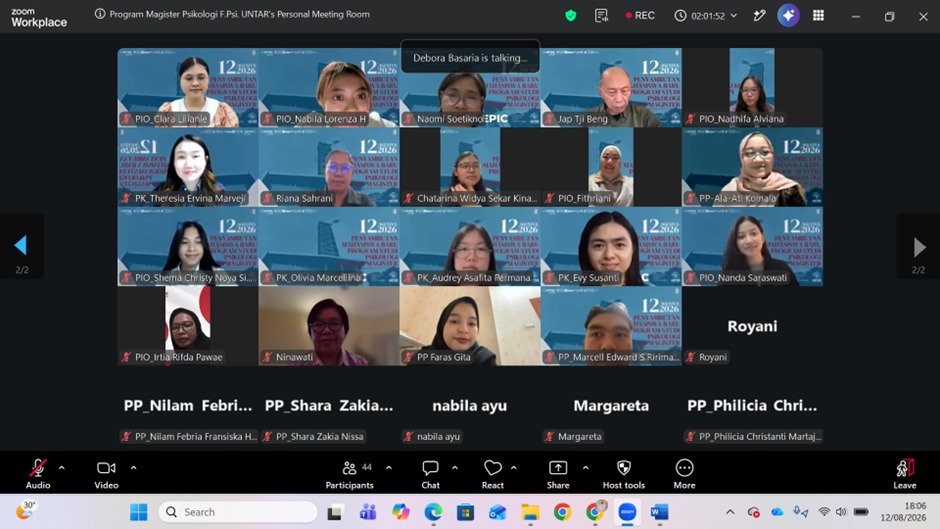
The Master’s Program in Psychology at the Faculty of Psychology, Tarumanagara University (UNTAR), welcomed 34 new students during an orientation event held online via Zoom Cloud Meeting on Wednesday (August 12). The new students will pursue their studies in one of three specializations: Family Psychology, Educational Psychology, and Industrial and Organizational Psychology.
The event, which took place in two sessions—from 4:20 p.m. to 6:00 p.m. WIB and continued from 7:00 p.m. to 9:00 p.m. WIB—served as an opportunity for students to become familiar with the academic environment, the academic community, the educational system, and the scholarly perspectives that will be part of their journey throughout their master’s program.
Become Part of the Academic Community at the UNTAR School of Psychology
The event was hosted by Debora Basaria, M.Psi., Psychologist, who kicked off the program by introducing the series of activities to welcome new students.
The Dean of the UNTAR School of Psychology, Dr. P. Tommy Y. S. Suyasa, M.Si., Psychologist, delivered an opening address and introduced the vision, mission, and values of the UNTAR School of Psychology to the new students.
In his presentation, Dr. P. Tommy Y. S. Suyasa, M.Si., Psychologist, explained that the vision of the UNTAR Faculty of Psychology is grounded in the EPIC values: Entrepreneurship, Professionalism, Integrity, and Caring Community.
The value of Entrepreneurship is reflected in the ability to identify problems and needs in the surrounding environment and to seek solutions. Behavioral issues encountered in daily life can serve as opportunities for learning and conducting research.
Meanwhile, Professionalism is demonstrated through efforts to produce solutions grounded in research and scientific approaches. Integrity emphasizes the importance of upholding ethical standards as academics, while Caring Community begins with concern for one’s immediate surroundings, including building relationships with classmates and fellow students in one’s field of study.
Dr. P. Tommy Y. S. Suyasa, M.Si., Psychologist, also expressed his appreciation for the admission of 34 new students—the largest number ever admitted to the Master’s Program in Psychology.
To realize this vision, the UNTAR Faculty of Psychology carries out a mission that is part of the implementation of the Tri Dharma of Higher Education, namely providing psychology education to produce high-quality and ethical graduates; conducting research that is published nationally and internationally; improving the quality of life in the community through community service or the application of psychological science; and building networks of cooperation and collaboration with various institutions, both domestically and internationally.
The Dean of the Faculty of Psychology at UNTAR also emphasized that the study of psychology does not end with mastering concepts. The knowledge gained must be reflected upon and applied in daily life. An understanding of emotional stability and happiness, for example, should be applied in one’s personal life as well as in interactions with others and society.
At the end of his remarks, Dr. P. Tommy Y. S. Suyasa, M.Si., Psychologist, welcomed the new students and congratulated them on joining the extended family of the UNTAR Faculty of Psychology.
Psychology: A Science That Enriches Our Lives
The next welcoming remarks were delivered by Dr. Monty P. Satiadarma, MS/AT, MFCC, DCH, Psychologist. Beginning his remarks with the word “Welcome,” Dr. Monty expressed his hope that the knowledge gained by the students would benefit society.
Dr. Monty emphasized the importance of research in higher education. Students in the Master’s Program in Psychology are expected not only to understand theory but also to develop research skills as an essential part of advancing the field of psychology.
The results of the research, in the form of a thesis, will eventually be presented and defended academically before an examination committee. Therefore, students need to carefully plan their study period and take proactive steps to complete their studies within the specified timeframe.
Furthermore, Dr. Monty P. Satiadarma, MS/AT, MFCC, DCH, Psychologist, emphasized that students’ academic work should not merely serve as a means to fulfill graduation requirements. Such work is expected to contribute to the advancement of scholarship while also providing tangible benefits to society and professional practice in their respective fields.
Thus, master’s programs are expected not only to produce graduates with increasingly advanced expertise but also to cultivate scholars capable of producing meaningful work that addresses the needs of society.
Preparing for a Master’s Program and Academic Outcomes
The Head of the Master’s Program in Psychology, Dr. Fransisca Iriani Roesmala Dewi, M.Si, provided an overview of the educational process that students will undergo. UNTAR’s Master’s Program in Psychology has been accredited as “Excellent,” with a course load of 42 SKS to be completed over three semesters in accordance with KKNI Level 8 requirements.
Dr. Fransisca Iriani Roesmala Dewi, M.Si, reminded students to manage their time effectively, especially since most of the new students are already working. The ability to balance the demands of work and study is one of the keys to successfully completing their education.
As part of the educational process, students are also required to produce research outputs published in scientific journals rated at least Sinta 3 or in international journals. In addition, research findings are expected to be implemented through community service activities.
It is also hoped that the findings of this study can be shared and put to use within their respective communities in the spirit of the EPIC values, particularly during the third semester.
Getting to Know the Faculty, Support Staff, and the Three Specializations
The event continued with an introduction of the faculty members and educational administrative staff who will support the students throughout their studies in the Master’s Program in Psychology.
Students are introduced to their course instructors and academic advisors, who come from diverse backgrounds and possess expertise in the field of psychology. Students also receive information about the support staff who will assist them with their academic and administrative needs throughout their studies.
A total of 34 new students will develop their skills through three specialization tracks. Eleven students chose Family Psychology, eight chose Educational Psychology, and 15 chose Industrial and Organizational Psychology.
These three specializations provide students with the opportunity to delve deeper into their studies in accordance with their interests and the fields they wish to pursue, while also connecting the field of psychology to various issues in family life, education, organizations, and society.

“No Regret”: Learning from Alumni Experiences
Thenisia Warinta, M.Psi., an alumna of the Master’s Program in Psychology who currently works as a civil servant in Jambi Province, also shared her enthusiasm for pursuing a master’s degree.
In her testimonial, Thenisia shared her experience of pursuing a master’s degree while working. According to her, this journey requires dedication, perseverance, and time-management skills. There are times when the demands of work and coursework force students to study late into the night. However, these challenges are ultimately considered worth the benefits gained.
Thenisia also emphasized the importance of gaining support from one’s workplace when deciding to pursue further education. For students who are balancing college with a job, communicating with their supervisors about their professional development needs is something that needs to be established from the very beginning.
In addition to support, determination and commitment are essential for maintaining consistency until the end of your studies. You need to keep your desire to learn alive, even when facing academic demands in subsequent semesters.
That experience convinced Thenisia that pursuing a master’s degree in psychology was a goal worth striving for.
In addition to gaining knowledge, the educational process also provided opportunities to build relationships, broaden her horizons, and develop as a person.
For Thenisia, the knowledge she gained while pursuing her master’s degree in psychology is not only useful for her career but can also be applied to her family life, household, and community. She also encourages new students not to hesitate to ask questions and engage in discussions with their professors throughout their academic journey.
This message serves as a reminder that pursuing a master’s degree may present challenges, but with determination, support, time management, and a willingness to keep learning, the process can be a valuable experience.

Balancing College and Work: Support, Motivation, and Commitment
Another inspiring message was shared by Allychia Nanalingdita Thea Putri, M.Psi., an alumna of the Master’s Program in Psychology who currently works in Talent Acquisition at a company.
Allychia shared her experience regarding the challenges of pursuing a master’s degree while continuing to work. According to her, one of the most important things to prepare for is support from supervisors and the work environment. When deciding to pursue further education as part of personal development, students need to communicate this to their supervisors in order to receive the necessary support throughout their studies.
In addition to support, determination and commitment are essential for completing the program. The decision to delve deeper into the field of psychology must be accompanied by a genuine commitment to see it through to the end of the program.
Balancing college and work certainly presents its own set of challenges. Allychia admits that on some occasions she still has to work on her college assignments until 11:00 p.m. or even midnight. However, she believes that these challenges still provide valuable experiences.
For Allychia, the educational process not only provides additional knowledge but also opens up opportunities to learn, broaden her horizons, and build relationships with friends. These various experiences make the challenges she faced during her studies feel worthwhile.
He also reminded new students not to hesitate to ask questions and engage in discussions with their professors. Interaction with professors is an important part of the learning process and can help students gain a deeper understanding throughout their studies.
Allychia’s message reinforces the idea for new students that pursuing a master’s degree while working does indeed require time management skills, support, and a strong commitment. However, when approached with a clear purpose and a willingness to keep learning, the process can become a valuable experience for personal and professional growth.
Public Lecture: “Psychological Perspectives/Approaches”
Moving into the second session, the program continued with a public lecture titled “Psychological Perspectives/Approaches,” presented by Dr. Monty P. Satiadarma, MS/AT, MFCC, DCH, Psychologist, which took place after the lunch break.
The public lecture provided an introduction to the importance of understanding various perspectives and approaches in psychology.
For master’s students, the ability to view phenomena from various perspectives is a crucial foundation for developing critical and analytical thinking.
Students are not only expected to understand concepts and theories, but they also need to be able to view a phenomenon from various perspectives, question the assumptions made, and connect psychological knowledge to real-world issues in society.
This perspective is relevant for students who plan to pursue studies in Family Psychology, Educational Psychology, or Industrial and Organizational Psychology.
Embarking on an Academic Journey with the EPIC Spirit
The orientation program for new students marked the first step for 34 students as they entered the academic environment of the Master’s Program in Psychology at the UNTAR Faculty of Psychology.
Entering a master’s program requires students to become more independent in their studies, expand their ability to read and critically analyze scholarly literature, actively participate in discussions, and develop research skills and evidence-based thinking.
Through this event, new students not only receive information about the degree programs but are also encouraged to understand their identity as part of the academic community of the UNTAR Faculty of Psychology.
With their diverse backgrounds and areas of interest, the 34 new students are expected to enrich the academic environment, foster collaboration, and expand the exchange of ideas between students and faculty.
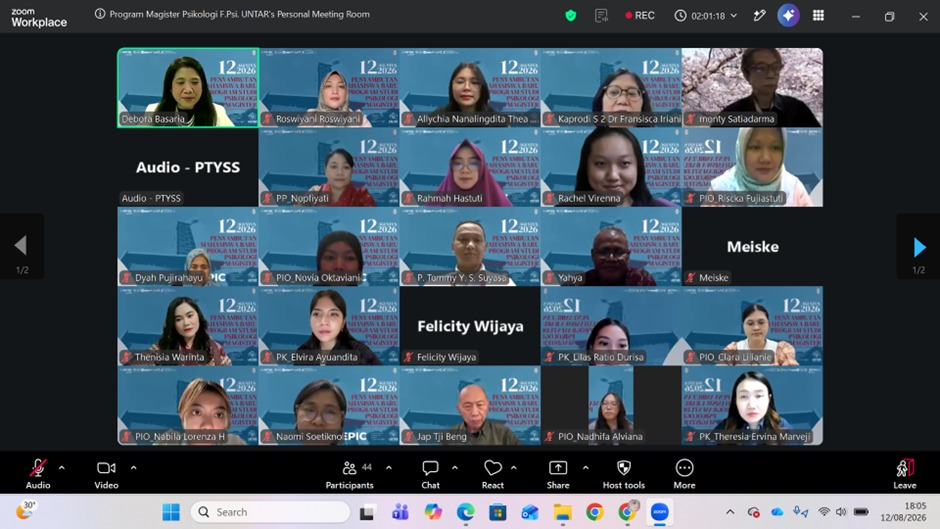
Welcome and congratulations to the 34 new students in the Master’s Program in Psychology at the Faculty of Psychology, Tarumanagara University.
We wish you all the best as you embark on your academic journey, develop your skills, broaden your horizons, produce meaningful work, and contribute to the advancement of psychology and society.