
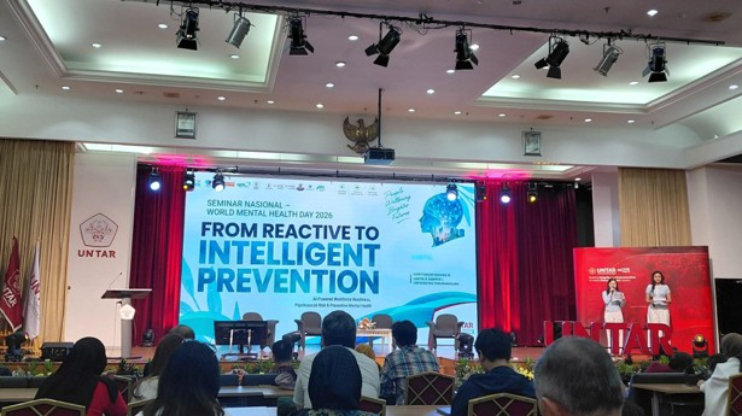
Maintaining mental health in the workplace requires more than just addressing problems that have already arisen; it also requires early prevention. The use of artificial intelligence (AI) can support this process, while ensuring scientific validation, data protection, and responsible human oversight.
This concept was the focus of the World Mental Health Day 2026 National Seminar titled “From Reactive to Intelligent Prevention: AI-Powered Workforce Readiness, Psychosocial Risk & Preventive Mental Health,” which took place on Saturday, October 10, 2026, in the Auditorium on the 8th Floor of Building M, Campus I of Tarumanagara University (UNTAR). The seminar brought together professionals from various fields to discuss mental health prevention and workforce readiness. Under the theme “World Mental Health Day 2026: From Mental Health Awareness to Organizational Intelligence,” the event emphasized the importance of collaboration among individuals, organizations, and professionals in creating a healthy and sustainable work environment.
In her remarks, UNTAR Vice Rector Assoc. Prof. Sri Tiatri, Ph.D., Psychologist, emphasized the importance of early detection and the use of AI that continues to prioritize people
as decision-makers who take into account competence, ethics, and human values.
In line with this, DexWellness founder David Wongso, S.Psi., MM., MBA., M.Min., emphasized that mental health is an integral part of human sustainability that requires interprofessional collaboration—ranging from workforce readiness and psychosocial risk management to mental health screening.
Meanwhile, the President of the Indonesian Psychological Association (HIMPSI), Dr. Andik Matulessy, Psychologist, highlighted the importance of promotion, prevention, and early identification, with success measured by access to assistance, the effectiveness of support, and improvements in the community’s quality of life. The event continued with a signing ceremony for a Memorandum of Understanding (MoU) between the HIMPSI Central Board and DexWellness.
Following the presentation, Mr. Edhi Tjahja Negara once again discussed the role of employee mental health in business success. Mr. Edhi also added that companies need to implement early prevention measures, support employee well-being, and maintain a balance between employee well-being and company productivity.
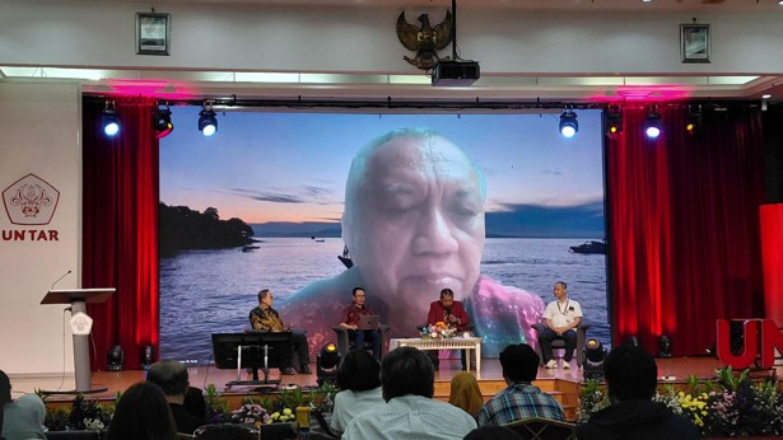
This idea then served as the basis for discussion during the seminar’s first panel session, “Preventive Mental Health Intelligence,” moderated by Dr. Raja Oloan Tumanggor. This session featured Prof. Dr. Abdul Kadir, Dr. P. Tommy Y. S. Suyasa, Psychologist, and David Wongso, M.M., M.B.A., Psychologist. Meanwhile, Dr. Sumaryono Sri Noto, M.Si., Psychologist, participated online.
The discussion began with Prof. Dr. Abdul Kadir, who explained that screening can help detect mental health risks early on. However, the results need to be followed up with further evaluation or professional help. Dr. P. Tommy also explained that screening tools need to be validated to ensure accurate results. Meanwhile, Dr. Sumaryono discussed the concept of “Change Spirit”—namely, the importance of managing stress, adapting, continuing to grow, and maintaining good relationships in the workplace.
Next, Mr. David introduced Jaydii Al, which helps detect mental health risks through facial scans and questionnaires. This technology has already been piloted at the Semanan Clinic with 120 participants, in collaboration with UNTAR’s Faculty of Medicine and Faculty of Psychology. Mr. David emphasized that AI only helps detect risks early on and does not replace the role of professionals.
During the discussion session, the moderator asked how mental health screening could be expanded without compromising the accuracy of the results. Prof. Abdul Kadir responded that screening tools need to be validated by comparing their results with those of standardized instruments. Mr. Tommy also added that such tools must be accurate, easy to use, and beneficial to their users.
The session then concluded with Assoc. Prof. Sri Tiatri presenting certificates to the speakers. The event continued with the signing of a Memorandum of Understanding (MoU) between ICCN and DexWellness Jaydii AI by Dr. Rosaria Mita Amalia and Mr. David Wongso, marking a collaboration with the career centers of 250 universities in Indonesia.
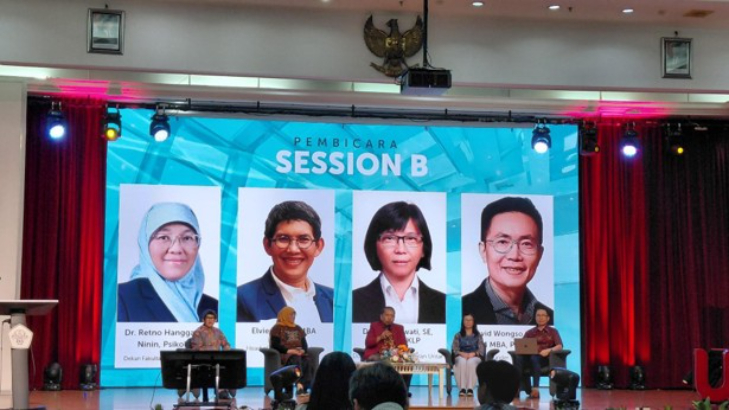
After the coffee break, the event continued with Session B, titled “Workforce Readiness Intelligence,” which addressed workforce readiness from physical, mental, and workplace perspectives. The session
This event features Dr. Retno Hanggarani Ninin, M.Psi., Psychologist; Elvira Putri, M.B.A.; Dr. dr. Ernawati, S.E., M.S., Sp.KKLP; and David Wongso, M.M., M.B.A., Psychologist.
In this session, Dr. Retno explained that work readiness is determined not only by competence but also by psychological well-being and a supportive environment. Next, Ms. Elvira highlighted fatigue as one of the causes of workplace accidents, while Dr. Ernawati emphasized the importance of assessing work readiness based on health status and job demands, as well as the use of AI for the early detection of health issues, although further validation is still needed to ensure accuracy.
The session continued with a demonstration of the Jaydii AI app by Mr. David and Mr. Afif. This app can help monitor employees’ well-being through daily check-ins and psychological questionnaires. The results can be used to identify health risks early on, but they still need to be validated by professionals.
During the discussion session, the moderator asked whether workers who pass a medical checkup but suffer from sleep disorders can still be considered fit for high-risk jobs. Dr. Retno explained that fitness for work must be assessed based on a worker’s health condition and the demands of the job, not just the results of a medical examination.
Ms. Elvira also added that companies can use checklists, supervisory oversight, and technology to detect fatigue. Meanwhile, Mr. David emphasized that AI only helps identify risks, while the final decision remains in the hands of humans or professionals. Dr. Ernawati also stressed that the results of the assessments need to be tailored to the workers’ conditions.
The second session concluded with the presentation of certificates by Assoc. Prof. Sri Tiatri, as a token of appreciation for the speakers and moderator.
Acara dilanjutkan dengan sesi “Call to Action” oleh Prof. Dr. Henndy Ginting, M.Si., Psikolog, yang menekankan pentingnya asesmen dan intervensi berbasis bukti ilmiah sesuai kebutuhan organisasi. Peserta diajak menyusun langkah nyata dalam 90 hari ke depan serta memperkuat kolaborasi lintas bidang, termasuk psikologi, kedokteran, HR, dan AI. Ia juga menyoroti pentingnya evaluasi hasil asesmen dan berpikir kritis dalam menggunakan data untuk pengambilan keputusan.
The event concluded with remarks from Mr. David, who encouraged participants to strengthen interdisciplinary collaboration in the development and application of science, including to address mental health challenges.